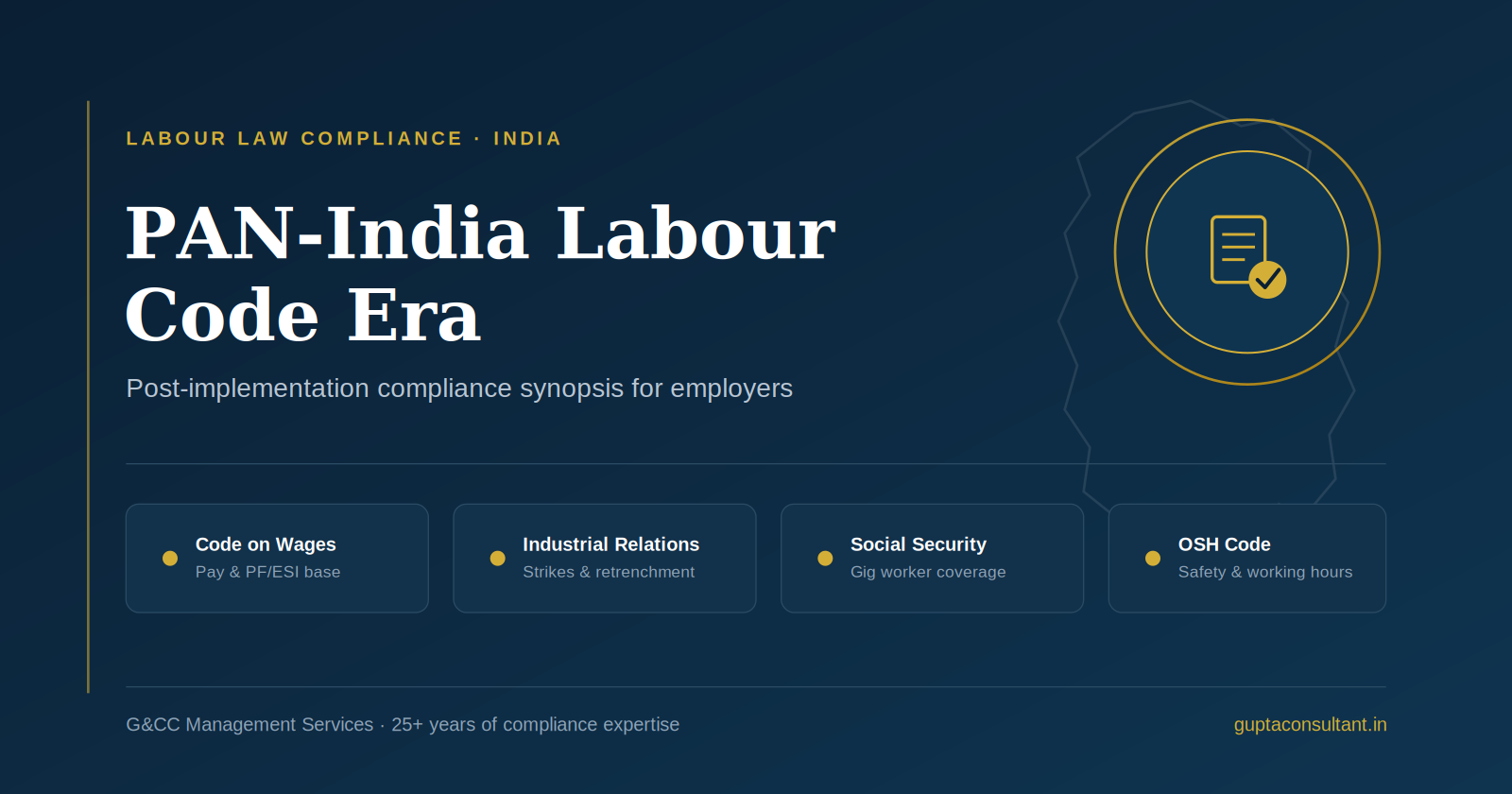
PAN-India Labour Law Compliance Post-Implementation: Labour Code Era Synopsis
For decades, the Indian employment scene was muddled by an eclectic array of 29 labor laws of central and state origin, dozens of registers, and a bewildering system of inspections and certifications. For businesses, HR managers and founders, it was often a dizzying chase for pan-India compliance.
Now, with the country having consolidated its labor laws into four broad codes and the relevant central and state labor rules being notified, the Indian workforce finds itself in a different regulatory environment.
Not only will the revised system make business compliance much smoother, it will also shake-up payroll, employee benefits and even safety requirements.
In this article, we take a detailed dive into this new world order and analyze what changes organizations need to keep on top of in order to ensure they are performing in accordance with the newly established rules.
Here are five important changes that every organization needs to factor in as they prepare to transition to the new environment.
1. The Four New Codes and How They Affect Business Compliance
India’s sweeping reforms are meant to consolidate a century’s worth of complex and occasionally conflicting labor laws pertaining to wages, industrial relations, social security, and occupational safety and health.
In essence, every single provision of the repealed statutes will be subsumed under the broad umbrella of the Codes.
Notably, the four new Codes are:
Code on Wages, 2019
Industrial Relations Code, 2020
Code on Social Security, 2020
Occupational Safety, Health and Working Conditions (OSHWC) Code, 2020
These Codes include new measures designed to address emerging issues like gig work and inter-state labor mobility.
While the new system’s overarching laws apply consistently at the center, the actual implementation at the state level needs more elaboration as labour is a concurrent subject.
2. The Five Big Compliance Changes Corporates Need to Factor In
In order to comply with the new labor code requirements, businesses will need to update internal regulations and employment contracts as well as payroll and compensation software.
However, which changes merit particular attention? Below are the five key compliance changes businesses need to plan for:
A. The New 50% Rule and How It Impacts Payroll
Per the Code on Wages, an employee’s Basic + Dearness Allowance (DA) has to comprise at least 50% of their overall compensation (CTC).
The impact of this change is particularly far-reaching as many organizations currently favor keeping Basic low and providing higher allowances to keep overall income and PF contributions in check.
Moving forward, if an employee’s allowances are found to comprise more than 50% of their overall compensation, the excess will have to be added to their Basic to determine applicability and amount of PF and gratuity entitlements – across India.
B. Fixed-Term Employment and Higher Gratuity Threshold
The new codes explicitly permit and regulate Fixed-Term Employment (FTE), including contractual roles.
In essence, FTEs will be entitled to regular wages and benefits as full-time permanent employees are.
As regards gratuity, FTEs who complete one year of continuous employment will become eligible for the benefit, as opposed to the previous 5 years for non-permanent workers.
Furthermore, organizations need to update their processes to issue a formal offer/contract letter to every employee.
C. New Standards Relating to Layoffs and Retrenchment
As per the new Industrial Relations Code, the threshold for obtaining approval from the appropriate government for lay-off, retrenchment or closure for manufacturing or industrial units has been raised from 100 to 300 workers.
This is an important step to provide more flexibility to employers while ensuring adequate employee safeguards are in place for larger manufacturing facilities.
D. The New Safety Provisions and Hours of Work
The OSHWC Code provisions cover a broad scope of provisions designed to govern and improve general working conditions for factory, mine or commercial establishment employees.
Notably, it provides an option to employees to adopt a 4-day workweek subject to an individual working day lasting no more than 12 hours and 5-day working time spread across 48 hours per week.
Furthermore, the rules specifically permit women to work night shifts across industries, subject to enhanced provisions for commuting and security as well as the express consent of the worker.
E. Single Window and State-Level Requirements
While the codes make extensive use of online, standardized registration and certification on a central level, implementing organizations need to be aware of additional requirements which apply at the state and sometimes even the city level.
As regards compliance officers across India, the new code provisions can be summarized thus:
Single-window procedures and digital labor rules are the new normal – including 5-year validity for certain compliances and documentation as compared to older annual reviews.
“Inspector Raj” is dead, long live the Inspector-cum-Facilitator! While the older approach focused on surprise and coercive inspections, the new rules envisage web-based random checks and a facilitator-led approach to compliance audits.
The new approach is much more employee-friendly and reduces the burden on businesses by removing the threat of exorbitant fines and penalties.
Aggregator Rules and Social Security Contributions
Enterprises that work with gig workers or those sourced via a platform need to update internal systems to reflect the changes to contribution rules for such employees and the applicable social security fund requirements.
3. Actionable Checklist for Transition to the New System
To ensure your organization is covered under the new rules in all the geographical areas it operates in, below is a broad checklist of actions needed:
Perform an audit of current compensation practices to ensure Basic + DA comprises the minimum 50% and revise CTC as needed for new employees.
Issue standardized appointment letters to all employees that specify the conditions, nature and length of employment, including full-time, fixed-term or otherwise.
Update payroll and HR software in line with the above, including the new gratuity rules and applicable full and final settlement requirements.
Update registers for employee-related needs as regards attendance, wages, overtime, and similar requirements.
Set up internal committees as required by the codes, including POSH, safety and other applicable committees.
Monitor news from the labour departments of all the states in which your warehouses, offices or retail stores operate to track any rule changes at the ground level.
Conclusion
Clearly, the reform has major implications for labor and HR compliance in India as we know it.
While this implies some transitional costs for organizations dealing with revisions to payroll, contracts and documentation, the larger system overhaul will create a stable environment for compliant organizations and workers alike.
By standardizing rules across a broad front, the change promotes higher standards of ethics in employment practices, addresses concerns of modern workers while opening the door for innovation and sustainable growth.