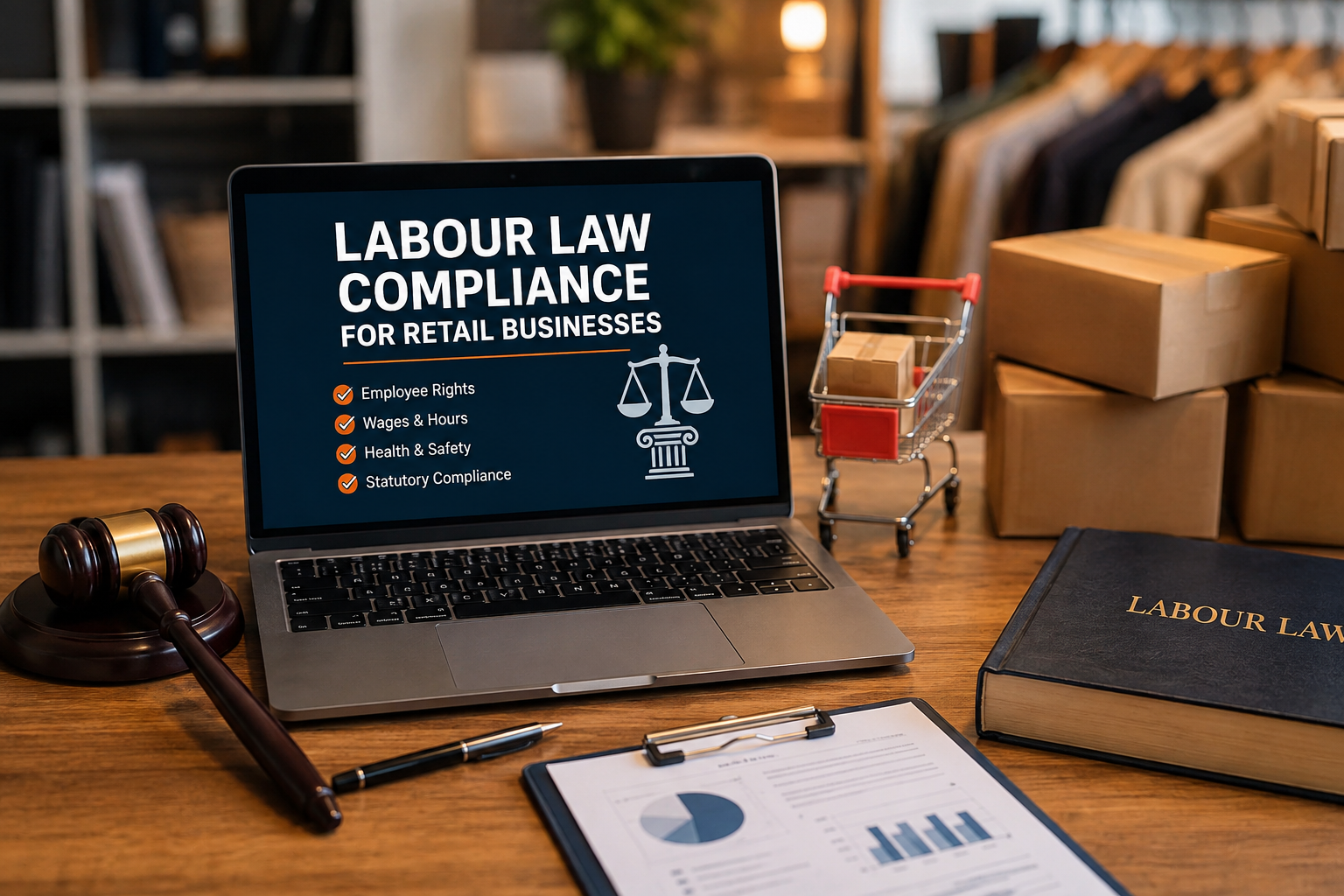
Mastering Labour Law Compliance in Multi-Location Retail
Challenges, City-Specific Realities & Tech-Driven Solutions
Scaling a retail business across multiple cities is exciting, but managing labour law compliance across different locations and states can be challenging.
Unlike a single-office business or manufacturing unit, retail chains often manage permanent employees, contract workers, part-time staff and outsourced workers across multiple stores. Different state regulations, employee turnover, shifts and contractor requirements make compliance increasingly complex.
A structured and technology-driven approach can help retailers reduce compliance risks while keeping operations efficient.
01 — The Unique Anatomy of Retail Compliance
A retail business may have a combination of permanent employees, contract workers, daily-wage staff, part-time employees and outsourced workers.
Stores must also comply with applicable Shops and Establishments regulations and other state-specific requirements.
Key areas can include:
Daily and weekly working hours
Weekly holidays and festive closures
Overtime and wage requirements
Employee records and registers
Notice board requirements
State-specific labour regulations
02 — City-Specific Compliance Realities
Multi-location retailers need to understand that labour compliance can differ from one state to another.
Mumbai — Maharashtra
Retail stores and mall outlets in Mumbai need to consider Maharashtra-specific labour and professional tax requirements.
Key considerations may include:
Shops and Establishments compliance
Professional tax
Applicable employee welfare requirements
Late-night shift arrangements
Local registrations and renewals
State-specific documentation
Bengaluru — Karnataka
Retail businesses in Bengaluru operate under Karnataka's applicable labour and Shops and Commercial Establishments requirements.
Important areas may include:
Working hours and wage compliance
Employee records
Welfare fund requirements where applicable
POSH compliance
Digital attendance and payroll records
Delhi-NCR — Gurgaon & Noida
Delhi-NCR presents an additional challenge because businesses operating across Haryana and Uttar Pradesh may need to manage different state-level requirements.
Retailers should carefully monitor:
State-specific minimum wages
Holiday schedules
Shops and Establishments requirements
POSH compliance
Employee and contractor documentation
Important: Requirements can change based on the state, business activity, workforce and applicable legislation. Retailers should verify the regulations applicable to each location.
03 — Core Challenges for Multi-Location Retailers
Multi-State Labour Law Maze
A national retail chain may need to manage different state laws, minimum wage requirements, filing deadlines and notice requirements simultaneously.
High Employee Turnover
Retail businesses often experience seasonal and high-volume hiring. Managing employee onboarding, UAN creation, PF/ESI requirements and Full & Final settlements on time can become difficult across multiple stores.
Vendor & Contract Labour Risk
Housekeeping, security, logistics and other activities are often handled through third-party contractors.
Any default in applicable PF, ESI, wage or documentation requirements by a contractor can create compliance risks for the principal employer.
Manual Record-Keeping
Managing employee records through physical registers and Excel spreadsheets may work for a small operation, but becomes increasingly difficult when a retailer operates dozens of stores.
04 — The Solution: Tech-Enabled Compliance Management
Manual compliance processes can become inefficient as retail operations grow. A technology-enabled compliance management system can centralise information and automate repetitive tasks.
Centralised Cloud Dashboard
A central dashboard can provide visibility into the compliance status of multiple stores and highlight pending or overdue activities.
Automated Statutory Updates
Labour regulations, minimum wages and compliance requirements can change. A technology-driven system can help businesses track applicable updates and deadlines.
Digital Employee & Vendor Management
Digital onboarding and vendor management can streamline employee documentation and help organise compliance information related to PF, ESI, TDS and other applicable requirements.
Automated Audit Trails
Regular audit trails and digital checklists can help retailers identify compliance gaps before an inspection or audit.
Mobile-based checklists can also support activities such as:
Notice board checks
Fire safety inspections
Store compliance checks
Employee documentation reviews
Why Technology Matters for Retail Compliance
As a retail chain expands, visibility and consistency become critical.
A centralised compliance system can help businesses:
Track → Monitor → Identify Gaps → Take Action → Maintain Records
This reduces dependence on scattered Excel files, physical registers and disconnected processes.
Conclusion
Labour law compliance is an essential part of successfully managing a multi-location retail business.
Expanding across cities such as Mumbai, Bengaluru, Gurgaon and Noida can create new compliance challenges because each location may have different labour requirements, wage structures, filing deadlines and documentation needs.
By combining centralised compliance management, digital records, automated reminders and regular audits, retailers can reduce compliance risks and manage their growing workforce more efficiently.
For a growing retail chain, compliance should be proactive, centralised and technology-driven—not dependent on manual Excel sheets and last-minute checks.